Archdiocese of New York
Federal Scholarship Tax Credit Resource Hub
Use your tax dollars to change a student’s future.
Overview
What Families and Donors Need to Know
The program will allow eligible taxpayers to receive a federal tax credit for donations to approved Scholarship Granting Organizations (SGO).
These donations can help families access educational opportunities and resources that meet their children’s needs.
The program is not just for Catholic school families. It can benefit eligible students across educational settings, including public, charter, independent, and Catholic schools.
Pending Guidance: Final IRS regulations will clarify filing procedures and documentation requirements. We’ll post updates here as Treasury guidance is released.
Resources for you
Find information for your role
Whether you’re a parent, parishioner, or a financial advisor here’s what the Federal Scholarship Tax Credit means for you and how to take part.
Parishioners
Support the children of your parish community by redirecting tax dollars you already owe.
Learn moreParents
Scholarships funded by this Federal Scholarship Tax Credit can help make a Catholic education possible for your family.
Learn moreFamilies & Friends
Help your school community make the most of this new opportunity.
Learn moreFinancial/Tax Advisors
A new Federal Scholarship Tax Credit your clients can use, and an easy way to help them support K–12 education.
Learn moreHow it works
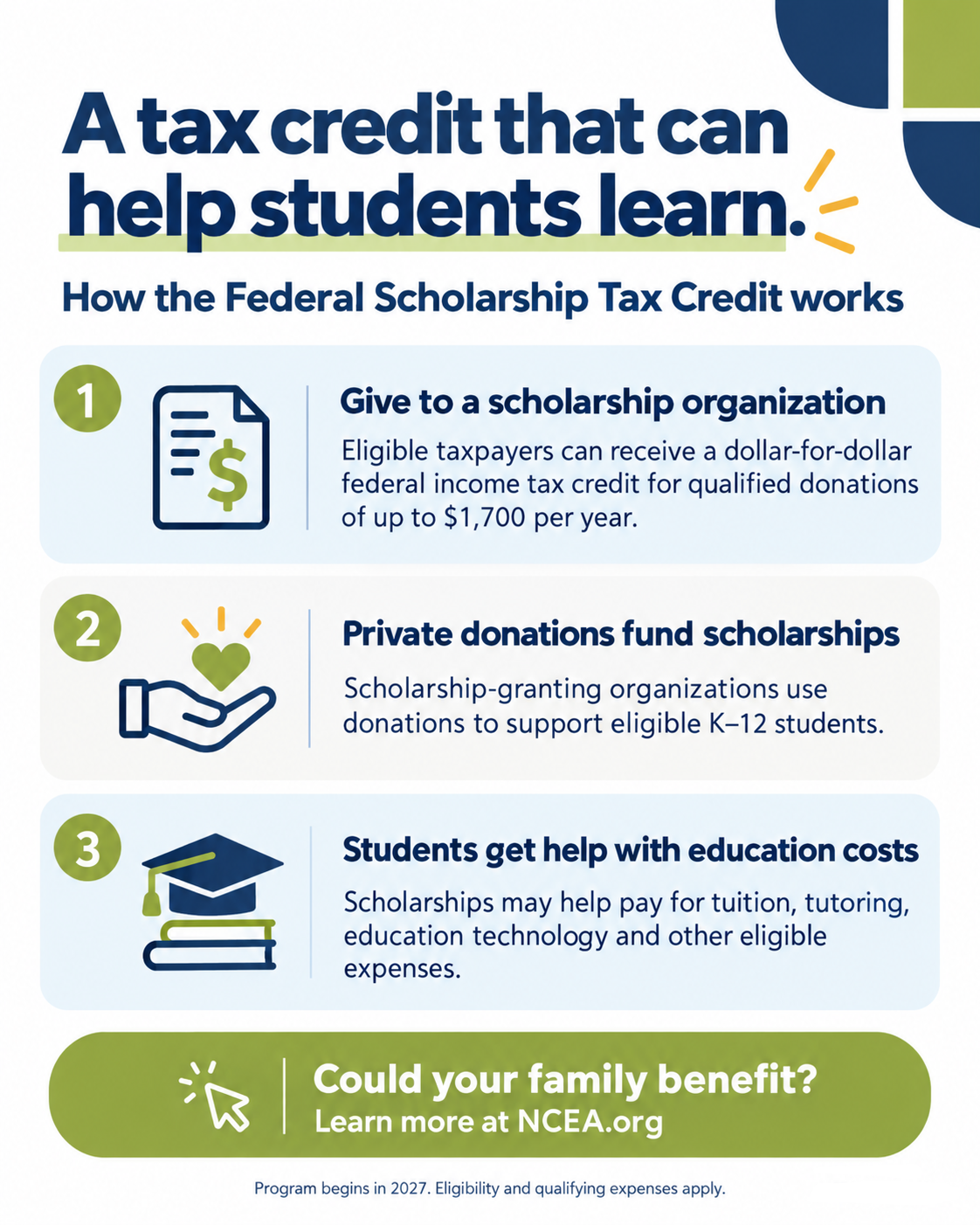
A tax credit that can help students learn
How the Federal Scholarship Tax Credit works
-
01
Give to a Scholarship Granting Organization
Eligible taxpayers can receive a dollar-for-dollar federal income tax credit for qualified donations of up to $1,700 per year for individuals or $3,400 per year for married couples filing jointly.
-
02
Private donations fund scholarships
Scholarship granting organizations use donations to support eligible K–12 students.
-
03
Students get help with education costs
Scholarships may help pay for tuition, tutoring, education technology and other eligible expenses.
Program begins in 2027. Eligibility and qualifying expenses apply.
Three Simple Steps
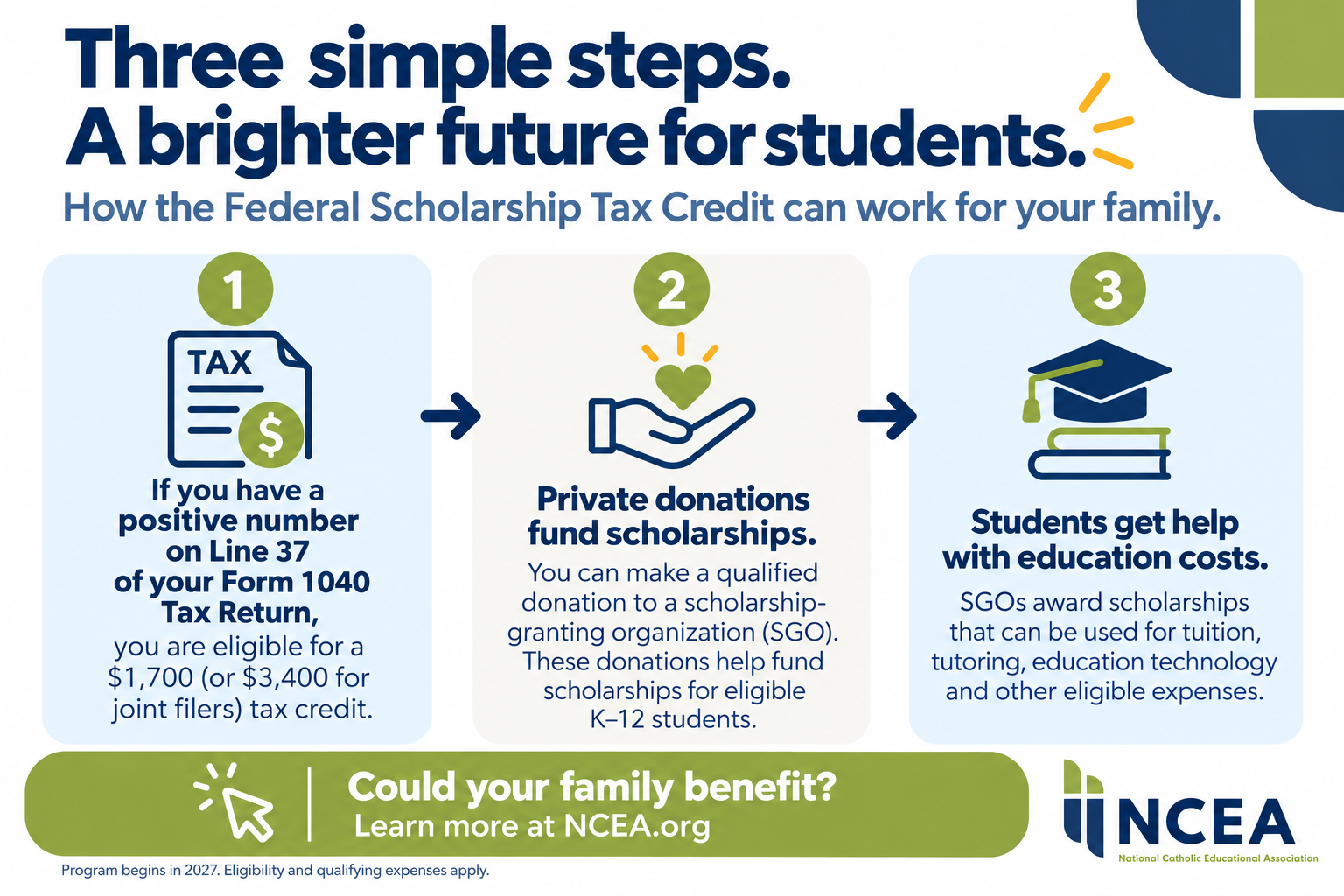
Three simple steps. A brighter future for students.
How the Federal Scholarship Tax Credit can work for your family.
-
01
If you owe federal income tax, you can take part.
Give up to $1,700 for individuals or $3,400 for married couples filing jointly to a scholarship granting organization and reduce your federal tax bill by the same amount.
-
02
Private donations fund scholarships
You can make a qualified donation to a scholarship granting organization (SGO). These donations help fund scholarships for eligible K–12 students.
-
03
Students get help with education costs
SGOs award scholarships that can be used for tuition, tutoring, education technology and other eligible expenses.
Program begins in 2027. Eligibility and qualifying expenses apply.
Frequently asked questions
Your questions, answered
On his podcast, All Good Things, Archbishop of New York Ronald Hicks sat down with Anne Lesser, President and CEO of the Invest in Education Foundation, and Sister Mary Grace Walsh, ASCJ, Ph.D., Superintendent of Schools for the Archdiocese of New York, to discuss the Federal Scholarship Tax Credit and the opportunities it could create for students, families and communities.
*Eligible taxpayers can receive a dollar-for-dollar federal income tax credit for qualified donations of up to $1,700 per year for individuals or $3,400 per year for married couples filing jointly.
What is the Federal Scholarship Tax Credit?
The Federal Scholarship Tax Credit is a program that allows eligible taxpayers to receive a federal tax credit when they donate to approved Scholarship Granting Organizations that award scholarships to students.
These donations help fund scholarships for eligible children and families, expanding access to educational opportunities and services. The program creates an opportunity for people to support students in their communities while receiving a tax benefit for their qualifying donations.
Is New York State participating?
Yes. New York State is opting into the program. The Archdiocese of New York is grateful to Governor Kathy Hochul for this decision, which will help make this new opportunity available to eligible students and families in New York. The program is scheduled to begin January 1, 2027.
How do the scholarships work?
Scholarships will be awarded by approved nonprofit organizations known as Scholarship Granting Organizations, or SGOs.
These organizations receive qualifying donations and use the funds to award scholarships to eligible students. We will share additional information about participating organizations and how families can apply as the program is implemented.
How do I claim the credit?
- Make a cash gift of up to $1,700 for individuals or $3,400 for married couples filing jointly to an approved SGO, and tell the SGO it’s a qualified Section 25F contribution.
- Keep the acknowledgment the SGO sends you.
- Complete Form 8525, Federal Scholarship Tax Credit, with the required SGO and donor numbers, and file it with your federal tax return.
Questions for families
Who can benefit from the scholarships?
The program is designed to help eligible students and families across different educational settings. It is not limited to Catholic school students or families.
Scholarships may support students attending Catholic, public, charter, and independent schools, subject to program requirements. This means the program can help children and families throughout New York, regardless of whether they currently attend a Catholic school.
Is this program only for Catholic school families?
No. The program is intended to benefit eligible students across educational settings, not just those attending Catholic schools.
The Archdiocese of New York supports opportunities that help children learn, grow, and reach their full potential. The program can provide educational assistance to eligible students and families while also helping make Catholic education more accessible to families who wish to choose it.
Who is eligible for a scholarship?
Under the program's income guidelines, students from households earning up to 300% of the area median income may qualify. Area median income varies by location and is determined using federal housing guidelines.
What can scholarship funds pay for?
Scholarships may help cover a range of eligible educational expenses, including:
Tuition and school fees
- Tutoring and academic support
- Curriculum and educational materials
- Special education services
- Educational technology and supplies
Questions for donors
Why should I consider donating?
A qualifying donation can help fund scholarships for eligible students and expand educational opportunities for children and families. The program provides a way to support students in local communities while potentially receiving a federal tax benefit.
Donors can support educational opportunities for children across school settings, including families who may be seeking assistance to access a Catholic education.
How does the federal tax credit work?
Eligible taxpayers may receive a dollar-for-dollar, non-refundable federal income tax credit for qualifying donations to approved Scholarship Granting Organizations, subject to federal rules and limits.
A tax credit reduces the amount of federal income tax a person owes. Because the credit is non-refundable, it generally cannot exceed the taxpayer's eligible tax liability.
How much can I claim as a tax credit?
Under the program, eligible individual taxpayers may claim a federal tax credit of up to $1,700 per year for qualifying donations. Married couples filing jointly may each claim up to $1,700, for a total of up to $3,400 on a joint return, subject to applicable requirements.
Donors should consult a qualified tax professional to understand how the credit may apply to their individual circumstances.
For parishioners
Parishioners
Support the children of your parish community by redirecting tax dollars you already owe.
Everyone Can be a Philanthropist
If you pay federal income tax, you can direct up to $1,700 or $3,400 for married couples filing jointly toward scholarships for Catholic educational programs instead of sending that amount to the IRS. Your federal tax bill is reduced dollar-for-dollar by the amount you contribute.
Why it matters
Catholic education forms the whole child, nurturing faith, strengthening character, and preparing young people to serve others. Every scholarship helps make this formation possible, opening the door to educational opportunities that support students and families while sustaining the mission of Catholic education in our communities.
How to give
- Make a cash gift of up to $1,700 or $3,400 for married couples filing jointly to an approved SGO, and tell the SGO it’s a qualified Section 25F contribution.
- Keep the acknowledgment the SGO sends you.
- Complete Form 8525, Federal Scholarship Tax Credit, with the required SGO and donor numbers, and file it with your federal tax return.
You don’t need to have a child in a Catholic educational program to give. Grandparents and friends of Catholic education are all welcome.
For parents
Parents
Scholarships funded by this Federal Scholarship Tax Credit can help make a Catholic education possible for your family.
How scholarships can help your family
Beginning in 2027, donations made through the Federal Scholarship Tax Credit will fund scholarships for eligible K–12 students. Scholarships may help pay for tuition and other qualifying expenses.
Who is eligible?
Eligibility depends on household income. Final income guidelines are being set by federal and state guidance, and we’ll update this page as details are confirmed. New York State is participating. Students from households earning up to 300% of the area median income may qualify; area median income varies by location and is determined using federal housing guidelines.
What you can do now
- Sign up for updates so you hear first when applications open
- Share this page with family and friends who may want to support donations
Can you give, too?
Yes. If you owe federal income tax, you can claim the credit yourself by giving to a qualified SGO, even if your own child is a scholarship applicant.
For families & friends
Families & Friends
Help your school community make the most of this new opportunity.
Families can give and benefit
Every family who pays federal income tax can make a qualified gift and claim, and so can grandparents, aunts and uncles, alumni and family friends.
Each gift helps fund scholarships for students across our educational programs.
Ask your circle
One of the most powerful things you can do is share this opportunity with the people who already care about your child’s education. A simple conversation with a relative or neighbor can turn tax dollars into tuition assistance, tutoring, and special education services.
Stay Connected and Informed
Stay connected with your school and the Archdiocese of New York for the latest information on scholarship opportunities, applications, deadlines and upcoming events. Keep your contact information up to date and check back regularly for additional updates as the program develops and new information becomes available.
For financial/tax advisors
Financial/Tax Advisors
A new Federal Scholarship Tax Credit your clients can use, and an easy way to help them support K–12 education.
The basics
The Federal Scholarship Tax Credit was established under the One Big Beautiful Bill Act and is codified at Section 25F of the Internal Revenue Code. It provides a nonrefundable, dollar-for-dollar federal tax credit of up to $1,700 per year for individual taxpayers and $3,400 per year for married couples filing jointly for cash contributions to qualified scholarship granting organizations. The credit applies to contributions made on or after January 1, 2027.
Sources:
- 26 U.S.C. § 25F (Cornell LII)
- Federal Register: Federal Scholarship Tax Credit, Proposed Rule (Oct. 2, 2026)
- Public Law 119-21 (govinfo)
- Foster: TEO Tax Update on SGO credit
Key points for your clients
- It is a credit, not a deduction, so it directly reduces federal tax liability
- The same contribution cannot be claimed as both a credit and a charitable deduction
- Contributions must go to an SGO on a participating state’s list
- The credit is nonrefundable, so clients need federal tax liability to benefit
- Clients claim the credit on Form 8525 and must list the SGO and donor numbers
Pending guidance
Final IRS regulations will clarify filing procedures and documentation requirements. We’ll post updates here as Treasury guidance is released.
Help us spread the word
We welcome partnerships with financial advisors who want to share this opportunity with their clients during tax planning season.
Sources
Sources and References
- 26 U.S.C. § 25F (opens in a new tab)
- 26 U.S.C. § 530(b)(3)(A) (opens in a new tab)
- Public Law 119-21 (opens in a new tab)
- IRS Proposed Rule REG-117199-25, 91 FR 62818 (opens in a new tab)
- Chalkbeat, “Hochul opts New York into federal school choice tax credit” (opens in a new tab)
- IRS, Federal Scholarship Tax Credit (FSTC) (opens in a new tab)
Links open external sites. Program details are subject to final IRS guidance.
This page is for general information only and is not tax or legal advice. Please consult a qualified tax professional about your situation. Program details are subject to final IRS guidance.