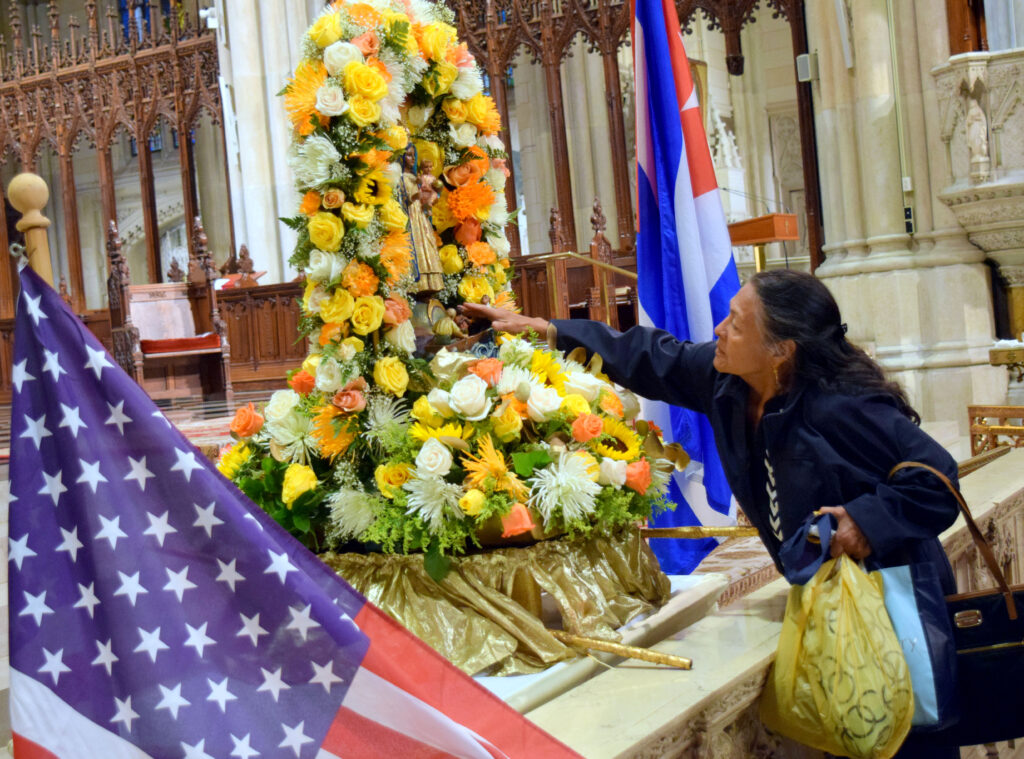
At St. Patrick’s Cathedral on Sunday Sept. 10, a 2 p.m. Spanish Mass is set in Honor of the Divine Child Jesus; later at 4 p.m., a Spanish Mass will be celebrated in Honor of Our Lady of Charity del Cobre.
Mass celebrations for the Divine Child Jesus is traditionally a Colombian custom, but this year in the Archdiocese of New York it is being promoted as a children’s Mass planned by the archdiocesan Children’s Parish Groups, according to the archdiocesan Office of Hispanic Ministry. Liturgies in honor of Our Lady of Charity del Cobre is traditionally a Cuban custom and will be celebrated as such this year in the archdiocese.
Father Nilson Camacho Guerra will serve as principal celebrant and homilist at the Divine Child of Jesus Mass; he is from the Diocese of Valledupar in Colombia.
Father Ernesto Avila Alonso from the Diocese of Brooklyn will be the principal celebrant and homilist of the Our Lady of Charity del Cobre Mass.
“We must propagate the faith – and the Divine Child Jesus, we must get closer to His tenderness,” Rosana Malaver, a lead organizer of the Divine Child of Jesus Mass, told The Good Newsroom. “And we have the great task of evangelization – evangelizing adults, and evangelizing children; this Mass is especially important for the children.”
Malaver is Colombian-born and a parishioner of Assumption parish in Peekskill, where she volunteers as coordinator of the Children’s Choir.
The Divino Niño, also known as Divino Niño de Bogotá or Divine Child Jesus, is a religious wooden statue of the child Jesus originating from Bogota, Colombia. A cross originally in the back was removed upon purchase in 1935 at a Bogota store by an Italian Salesian priest, Father Giovanni Rizzo, assigned to Colombia.
The 17-centimeter-high statue with arms outstretched and wearing a traditional pink robe or tunic has an inscription "Yo reinaré" ("I will reign") at its base, an inscription requested by Father Rizzo. It is one of the most popular religious images in Colombia, especially among Catholics, and reportedly has miraculous powers of healing.
The story of the Cuban Virgin of Charity: In 1612 an African slave and two indigenous Cubans rowed a boat to collect salt in the Bay of Nipe; they spotted a 16-inch statue of Mary on a tablet floating on the waves. In the statue’s left hand was baby Jesus, in the right a cross. A sign beneath the statue said, “I am the Virgin of Charity.” The statue’s clothes were miraculously dry.
“For us Cubans, this word (charity) has a great and beautiful meaning because it is the name of our Mother and Patroness. Our Lady of Charity, as an image, is symbol of the "cubanía" (that which pertains to all things Cuban) that unites all Cubans, believers and unbelievers alike,” Archbishop Dionisio G. García Ibáñez of Santiago de Cuba wrote in 2012 in anticipation of a papal visit from Pope Benedict XVI that year, the 400th anniversary of the finding of the statue.
“But charity, love, is the only virtue that can make possible that all Cubans be brothers and sisters to one another. The opposite of charity is hate; hate doesn't build anything, division doesn't build anything. The devil is the father of lies and disunion, but charity is what unites us, and it always comes from God. That's why the Holy Father comes to visit,” added Archbishop Garcia, who was then-president of the Conference of Catholic Bishops of Cuba.