Home / Seminary / Saint Joseph's Seminary (Dunwoodie) / Mission Statement and Information

Mission Statement and General Information

The mission of St. Joseph's Seminary and College is to form and educate men to serve as priests of Jesus Christ for the Archdiocese of New York, other dioceses, and religious communities.

The Seminary also educates and forms candidates for ordination as Permanent Deacons.

Through its Institute of Religious Studies, the Seminary provides graduate theological education to laity, religious, and clergy.


Mission Objectives

I. As the major seminary of the Archdiocese of New York, the purpose of Saint
Joseph's is to form and educate candidates for the ordained priesthood who, as
priests, will have a clear sense of their identity as ministers who are set aside to
act in the name and person of Jesus Christ, Shepherd and Head of the Church, and
who exercise a priesthood distinct from the common priesthood of all the baptized.

Saint Joseph's Seminary aims to assist the seminarian in his effort to establish
an intimate relationship with God the Father in Jesus Christ, His Son, through the
Holy Spirit. This relationship is nourished by Sacred Scripture and Tradition, celebrated especially in the Eucharist, and marked by sincere devotion to Mary, the Mother of God and Mother of the Church.

Through their inter-related components of priestly formation - human, spiritual,
intellectual, and pastoral - the Seminary strives to train men, called as priests to
be living images of Jesus Christ, to become more like Christ, the Good Shepherd,
men of deep humility and genuine pastoral charity. The Seminary prepares the
seminarian in a special way in the three-fold office of Christ: teaching the Gospel, celebrating the divine mysteries, and shepherding God's people. In this deep communion with the whole Church and its fidelity to Church teaching, the Seminary prepares its future priests to be men of ecclesial communion, united by special bonds with the Pope, the College of Bishops, their own Bishop, other priests, deacons, consecrated religious and the lay faithful.

The Program of Priestly Formation (PPF) (NCCB, fourth edition, 1992) states,
"Seminarians presented for ordination should be converted to the service of Christ, understand the tradition of the Church, and possess the attitudes and skills necessary to begin the priestly ministry" (No. 249).

At Saint Joseph's Seminary, students follow an academic curriculum leading to
the professional degree of Master of Divinity and the academic degree of Bachelor of Sacred Theology awarded through the Pontifical University of St. Thomas Aquinas in Rome. Eligible candidates may also obtain an advanced academic degree, Master of Arts (Theology). For students preparing to enter the major seminary, Saint Joseph's
Seminary provides a non-degree program of spiritual and academic formation at Saint John Neumann Residence and Hall. Candidates, who are college graduates, take courses prerequisite to seminary study in a non-degree program offered on campus. College students prepare to enter the Master of Divinity program by completing studies in philosophy and theology as they pursue a bachelor's degree at nearby Catholic institutions.

II. The Diaconate Formation Program, a non-residential and non-degree program, provides candidates for ordination to the Permanent Diaconate an extensive program of human, spiritual, theological and pastoral formation in accord with the principles of the Basic Norms for the Formation of Permanent Deacons promulgated by the Congregation for Catholic Education.

III. Saint Joseph's Seminary grants a Master of Arts (Religious Studies) degree program offered by the Institute of Religious Studies to qualified students, lay, religious, and clergy. This program of study, faithful to the Magisterium of the Church, provides doctrinal formation and on-going enrichment for those who seek a fuller understanding of Catholic theological traditions.

IV. Enriched by the cultural and educational treasurers of the metropolitan New York area, the Seminary seeks to educate and form its seminarians, clergy, and other students for a developing church in a dynamic society. Saint Joseph's Seminary looks to the future, it continues to develop its program by fostering creative scholarship utilizing the intellectual and cultural resources of the New York region.

General Information History and Description


Saint Joseph's Seminary, Dunwoodie, is the fifth in a series of educational institutions established for the formation clergy for the Archdiocese of New York. It traces its ancestry to parent seminaries in Nyack (1833-34), Lafargeville (1838-40), and Fordham (1840-61), all in the State of New York, and immediately to Saint Joseph's Provincial Seminary at Troy, New York (1864-96).


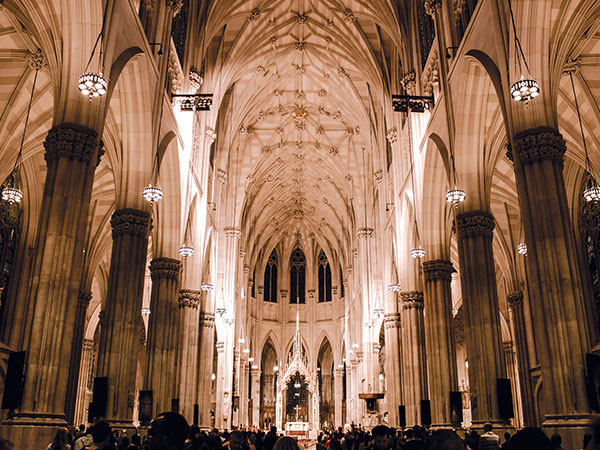
On May 17, 1891, Archbishop Michael J. Corrigan, desiring to relocate the seminary closer to his episcopal city, laid the cornerstone of the present Saint Joseph's in the Dunwoodie section of Yonkers, just a few miles north of New York City. The first scholastic year began September 21, 1896, with ninety-eight students. Bishop Bernard McQuaid of Rochester described the newly-completed Dunwoodie as "the grandest seminary building in Christendom" in 1896 even though he had just completed his own Seminary-St. Bernard's in Rochester. For the first ten years the seminary was under the direction of priests of the Society of Saint Sulpice, who composed the majority of the faculty. The eminent historian Fr. John Tracy Ellis has asserted that Dunwoodie, for the first twelve years of its existence, ranked second only to the Catholic University of America in its contribution to American Catholic intellectual life. In 1906, St. Joseph's reverted to the control of archdiocesan authorities and has since remained under an administrative and academic staff composed largely of diocesan priests. Successive Archbishops of New York, Cardinals Farley, Hayes, Spellman, and Cooke have enlarged the institution, notably by the addition of a residence wing in 1907, so that it presently provides accommodations for approximately 160 students in single rooms. A new library was constructed in 1953. In 1967 Cardinal Spellman dedicated the recreation center. In 1983 Cardinal Cooke restored the main chapel of the Seminary. In 1995 Cardinal O'Connor completed the restoration of the Chapel in preparation for the historic visit of Pope John Paul II on October 5, 1995.


Saint Joseph's Seminary extends for forty acres atop Valentine Hill. Its buildings are of gray mile-square granite, most of which was quarried on the seminary site. The main building is in early Renaissance style, and the cross over the cupola reaches one hundred and fifty feet above ground level.


In the main building, the chapel, auditorium, classrooms, meeting rooms, offices, and dining facilities are on the first floor and the rooms for faculty, students, and guests on the three upper floors. The Chapel of Our Lady Queen of the Apostles on the third floor was opened in 1955.


The Archbishop Corrigan Memorial Library is a separate building of four stories on the fourth side of the cloister, with entrances from the first floor of the main building and from outside.


To the west of these buildings are the outdoor recreational facilities of the seminary: a baseball and softball diamonds, soccer field and tennis court, and several walkways. The Cardinal Spellman Recreation Center completed in May 1967 contains basket- ball courts, squash courts, a swimming pool, steam rooms, and bowling lanes.

The campus includes the Institute of Religious Studies, Permanent Diaconate Office, and Vocation Office, all of which are housed in what was originally a convent. The Archdiocesan Instructional Television facilities are also located on the seminary property. On May 8, 1998, ground was broken for the Archbishop John Hughes Archival Center which will become the new home for the archives of the Archdiocese of New York upon completion in the Summer of 1999.


Purpose and Program


As noted in our Mission Statement, Saint Joseph's Seminary and College exists primarily for the formation of candidates for the priesthood of the Catholic Church. Its responsibility, therefore, encompasses the human, spiritual, intellectual, pastoral, and cultural formation of its students.


The Spirituality Year consists of a specialized program which concentrates on human and spiritual formation. It takes place at Mary Immaculate Seminary in Northampton, Pennsylvania, under the leadership of Dunwoodie faculty in conjunction with priests from Philadelphia and other dioceses. This is followed by the academic course which comprises eight semesters of professional study with concentration on theology and allied disciplines. Specialized information and skills, however, form only a part of the program, and the eight semesters of theology presuppose a training which is broadly classical in scope and tradition, humanistic in approach, and scientific in method. After six semesters a student is eligible for the degree of Master of Divinity. Upon completion of this degree qualified students may apply for the Master of Arts in Theology available during the fourth year of study.


At the end of six semesters of professional study, the seminarians are evaluated by the Rector and his faculty for the presentation of worthy candidates to the Bishop for ordination to the Order of Deacon. Ordination to the Order of Priest is considered at the conclusion of the Fourth Year.
While the prescribed courses offer an intensive preparation for the pastoral ministry on the parish level, they cannot provide all that may be required for special priestly assignments. In the New York Archdiocese the latter include education, social work, military chaplaincy, and diocesan administration. University courses leading to requisite graduate degrees are usually undertaken after ordination to prepare for such positions.


Prepatory Programs


In the Fall of 1977, the St. John Neumann Residence began on the Dunwoodie campus. The Neumann Residence serves both as a residence for students attending local colleges and as a pre-theologate for college graduates. When the number of students outgrew the original location, the Neumann Residence was moved to the former Visitation Monastery in the Riverdale section of the Bronx in the Fall of 1980.


Cathedral Preparatory Seminary, located in Rye, New York, is a four-year high school seminary conducted by the Archdiocese of New York.


The Library


On September 23, 1953, Francis Cardinal Spellman dedicated the new library building to the memory of Archbishop Michael A. Corrigan, builder and benefactor of the design and administration. The library strives to bring together the student and research resources without restrictions or delay.


The book collection of almost 81,000 volumes, including over 13,000 bound periodicals, reflects more than a century of efforts by scholars, librarians, and benefactors. Currently, the library purchases at least 1,000 volumes each year to add to the core collection and subscribes to more than 260 periodicals. The Archbishop Corrigan Library has been enriched by many outstanding collections, notably the libraries of Archbishop Corrigan, Cardinal Spellman, Countess Mary Young Moore, and the Rev. Patrick J. Brady. As a result, all areas of knowledge are broadly represented in the collection while the main concentration of research materials focuses on the sacred sciences.


The library is now "online," with the bibliographic database maintained by the Multi-Public Access Library System (MPALS). Using any one of the five terminals provided, library patrons can search the complete catalogued holdings of our own library, as well as the holdings of more than 25 other area libraries and library systems. Access to online periodical and newspaper indices is also included.

Archives

The Archives of the Archdiocese of New York are temporarily located in the library and will be moved to the new Archbishop John Hughes Archival Center upon completion.